


The crystal structure of nickel-based alloys is primarily a high-temperature stable face-centered cubic (FCC) structure. To improve their heat resistance, a large number of alloying elements are added. These elements form various secondary phases, enhancing the high-temperature strength of nickel-based alloys. The types of secondary phases include various forms of MC, M23C6, M6C, and M7C3 carbides, mainly distributed at grain boundaries, as well as structurally coherent ordered mesometallic compounds such as γ’ or γ”. The chemical composition of γ’ and γ” phases is approximately Ni3(Al, Ti) or Ni3Nb. These ordered phases are very stable at high temperatures, and their strengthening can result in excellent creep rupture strength. Figure 1 shows the microstructure of a typical nickel-based alloy:
Figure 1: Microstructure of a typical nickel-based alloy
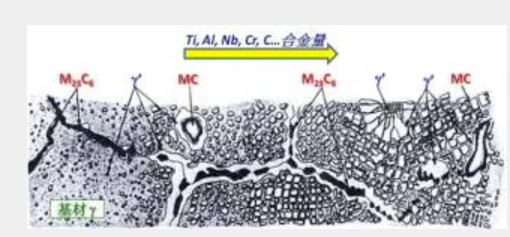
With increasing alloying degree, the microstructure exhibits the following trends: the number of γ’ phases gradually increases, their size gradually enlarges, and they change from spherical to cubic. Different sizes and morphologies of γ’ phases appear within the same alloy. Furthermore, in cast alloys, γ+γ’ eutectics formed during solidification occur, with discontinuous granular carbides precipitating at grain boundaries and surrounded by a γ’ phase film. These microstructure changes improve the alloy’s properties. In addition, modern nickel-based alloys have very complex chemical compositions and high saturation levels. Therefore, strict control of the content of each alloying element (especially the main strengthening element) is required; otherwise, other harmful intermetallic phases, such as σ and Laves phases, may precipitate during use, impairing the alloy’s strength and toughness.
Leave Your Message
Post time: Feb-05-2026